Exception Classes in Java
During program execution, situations may arise that require special handling. They may represent abnormal or erroneous conditions, situations that were not anticipated by the programmer, or even alternative execution flows. These conditions are called exceptions.
In Java, exceptions are represented by objects belonging to the Throwable class or one of its subclasses. The exception hierarchy is important for understanding which exceptions can be thrown, caught, and handled by programs.
Throwable
Throwable is the base class of the exception hierarchy in Java. Objects of this class store information about a particular occurrence and allow this information to be transferred from the point where the exception occurred to the code responsible for handling it.
Only objects belonging to Throwable or one of its subclasses can be thrown by the JVM or by the programmer using throw. Likewise, a catch clause can only catch objects belonging to this hierarchy.
Among the main methods of Throwable are getMessage(), which allows the message associated with the exception to be obtained, and printStackTrace(), which displays the execution stack trace up to the point where the exception occurred.
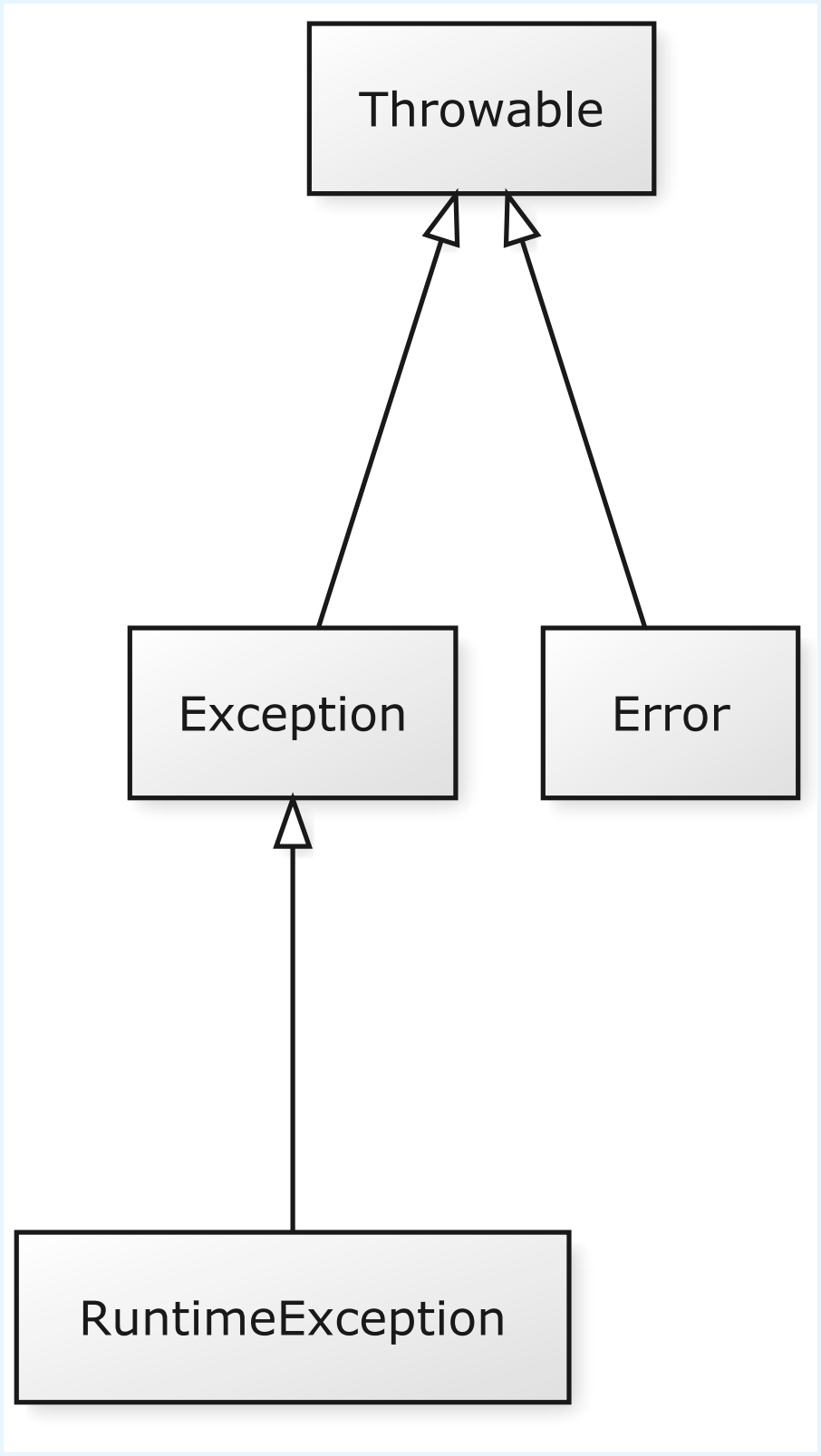
The Throwable class has two direct subclasses: Exception and Error.
Error
The Error class represents serious conditions from which an application generally cannot recover. These are abnormal situations that normally should not occur during program execution.
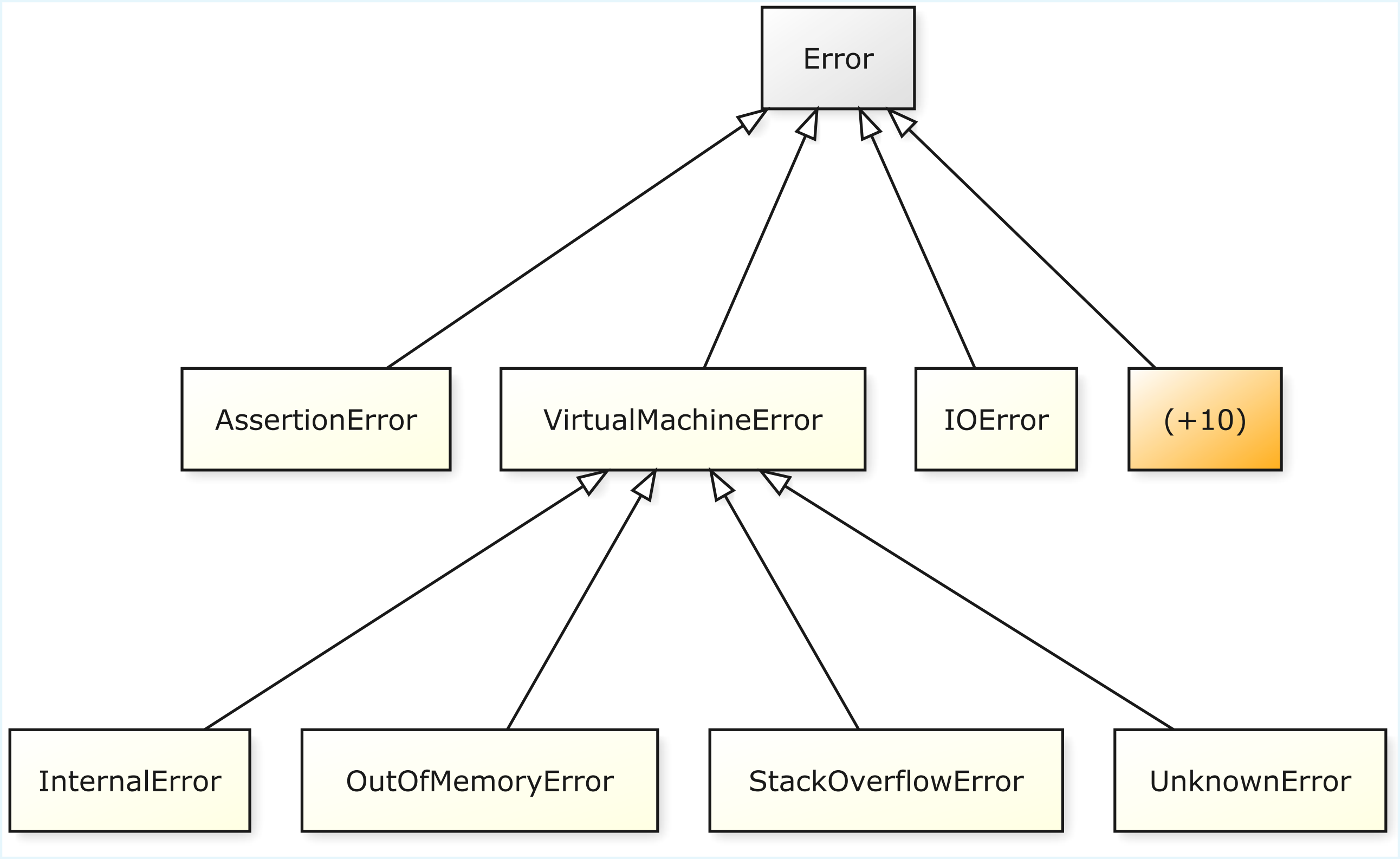
Some important subclasses of Error are AssertionError, IOError, and VirtualMachineError. The latter has, among others, subclasses such as InternalError, OutOfMemoryError, StackOverflowError, and UnknownError.
Errors can be thrown by the JVM itself, often as a consequence of conditions detected by the operating system or the runtime environment. They can also be explicitly produced by the programmer, for example, through assert or throw.
Exception
The Exception class represents exceptions that, under certain circumstances, can be handled and from which the application can recover.
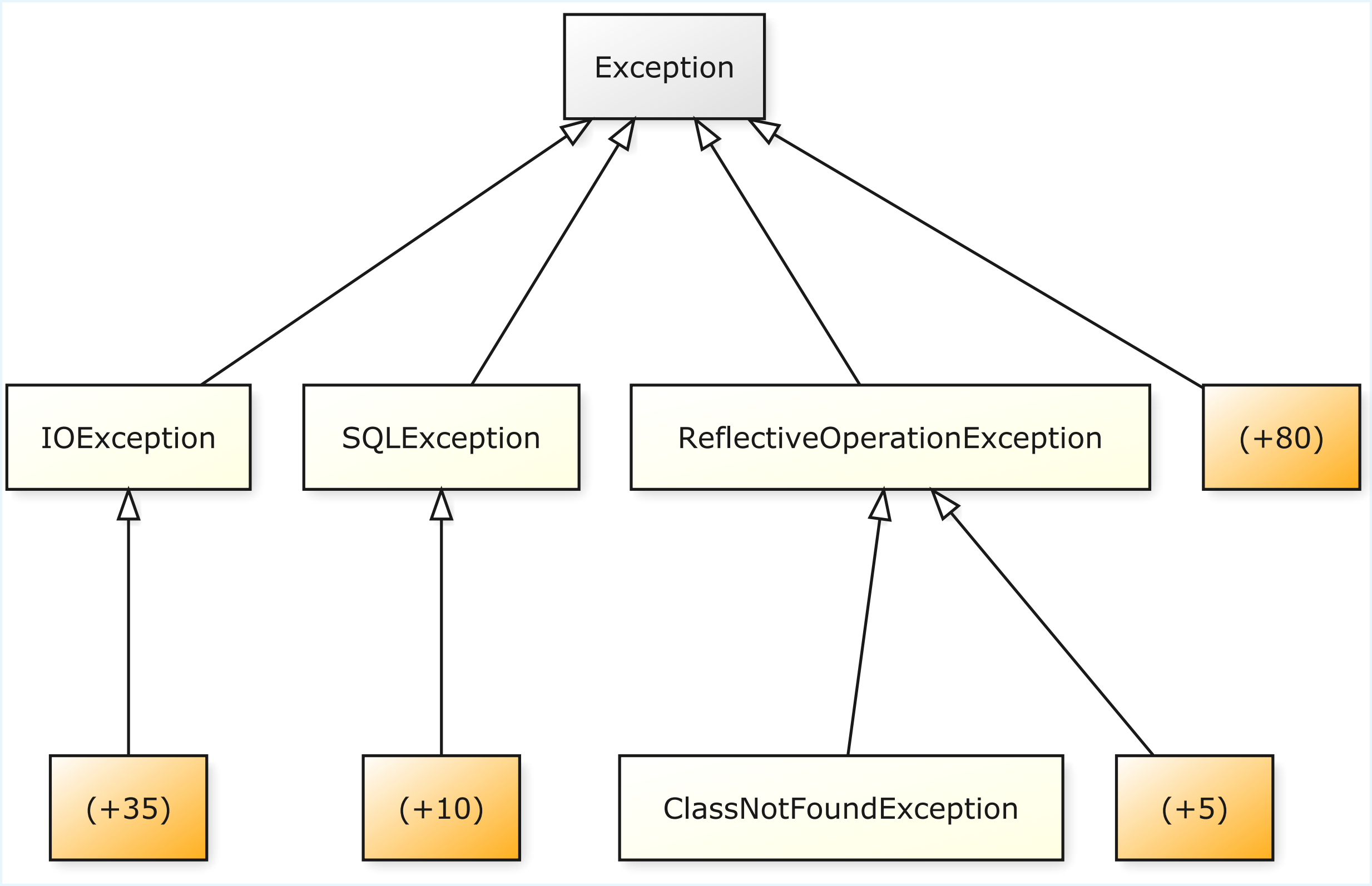
Its subclasses include IOException, SQLException, ReflectiveOperationException, ClassNotFoundException, and RuntimeException.
The Exception subclasses that are not subclasses of RuntimeException are called checked exceptions. The compiler requires them to be explicitly accounted for by the program. This can be done by catching the exception with a catch clause or by declaring, using throws, that the method may throw it.
RuntimeException
Among the subclasses of Exception, RuntimeException stands out. It and its subclasses are called runtime exceptions.
RuntimeException and its subclasses are unchecked exceptions. The compiler does not require them to be explicitly handled with try/catch or declared with throws.
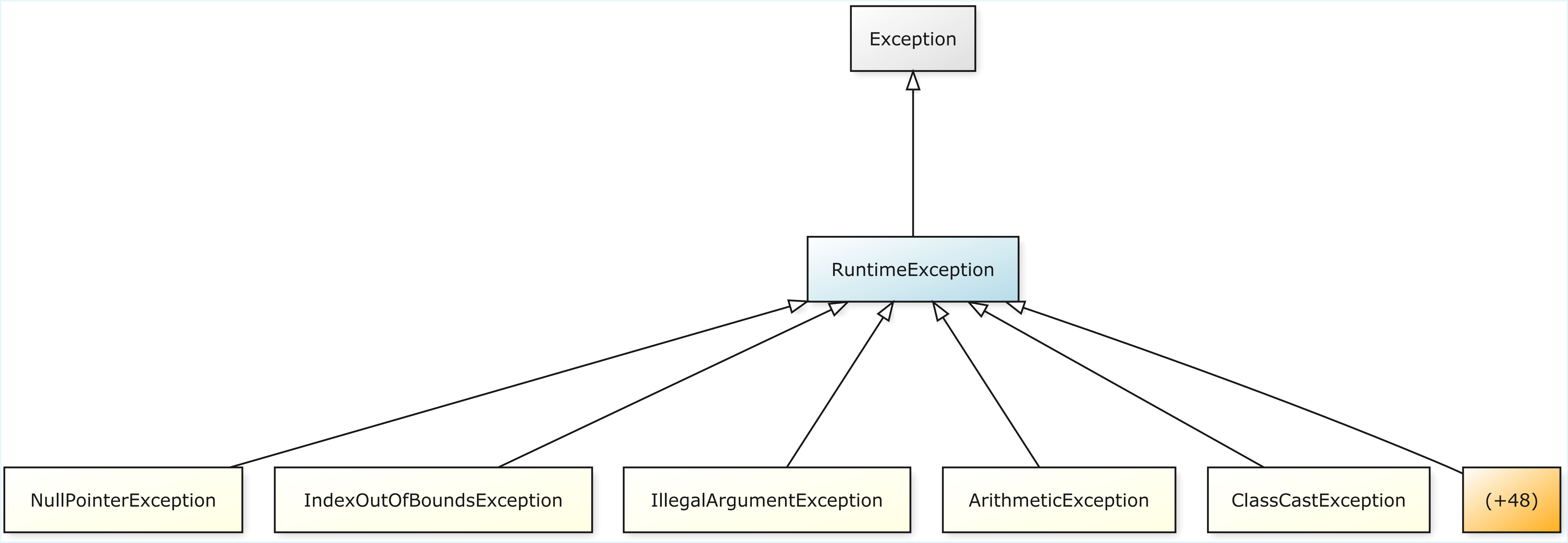
This type of exception usually represents logical errors or incorrect use of a program. Common examples include:
ClassCastException: occurs when an explicit type conversion is not possible.IllegalArgumentException: indicates that a method received an argument considered invalid or inappropriate.IndexOutOfBoundsException: occurs when an attempt is made to access a nonexistent position in an indexed structure.NullPointerException: occurs when an operation is performed on anullreference.
A method that may throw a RuntimeException does not need to declare this possibility with throws. Naturally, it is still possible to catch and handle these exceptions with try and catch.
In practice, many RuntimeException instances indicate problems that could have been prevented by the program itself. When one occurs, it is usually important to investigate its cause and fix the problem rather than simply catch the exception.
Checked and unchecked exceptions
An important distinction in Java’s exception hierarchy is between checked and unchecked exceptions.
Throwable and all of its subclasses that are not subclasses of RuntimeException or Error are called checked exceptions. RuntimeException and its subclasses, as well as Error and its subclasses, are called unchecked exceptions.
Checked exceptions must be handled or explicitly declared by the program. This means that when a method can throw a checked exception, it must be handled by a catch clause or declared in the method’s throws clause.
Unchecked exceptions, on the other hand, do not need to be explicitly handled or declared. The compiler does not require RuntimeException, Error, or their subclasses to be caught or declared.
In simplified form, the hierarchy can be visualized as follows:
Throwable
├── Error
└── Exception
    └── RuntimeException
This organization allows handling to be performed at different levels of the hierarchy. A catch clause can, for example, catch a specific exception or one of its superclasses, depending on the desired behavior.
Understanding this hierarchy is fundamental to understanding Java’s exception-handling mechanism and to deciding which exceptions should be handled, which should be propagated, and which represent errors that need to be fixed in the program itself.
This article is adapted from content in the book Orientação a Objetos com Java, by Eduardo Kessler Piveta.